
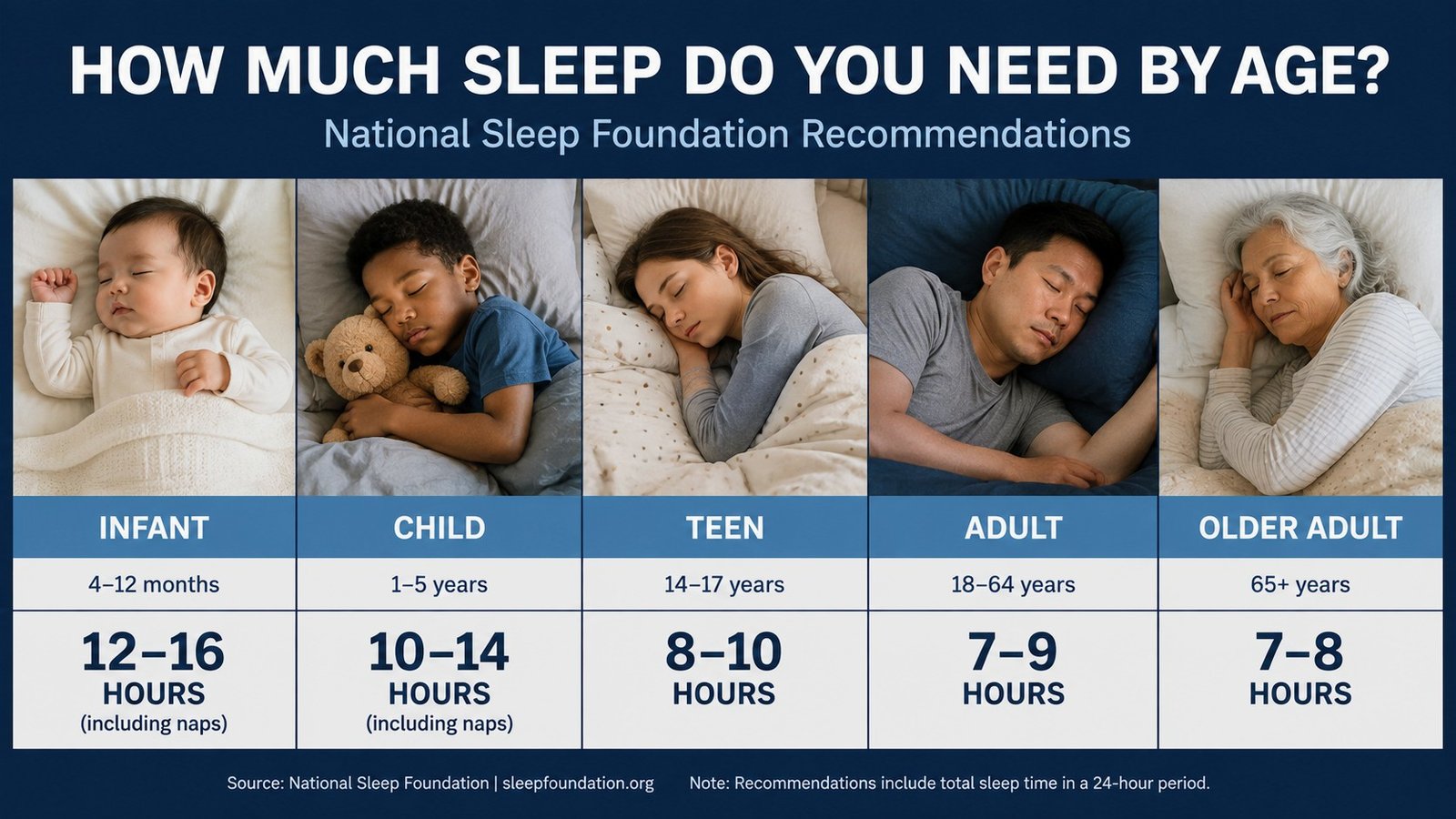
How much sleep do you need by age? It’s one of those questions that seems simple until you actually try to answer it for yourself. A newborn practically lives in sleep mode, while a healthy adult can often get by on seven solid hours.
If you’ve ever lain awake wondering whether your own sleep habits stack up, you’re far from alone. This guide breaks the numbers down stage by stage, using guidance from the CDC and NIH, so you can see exactly where you fall — and what to do if something feels off.
Quick Answer: Most adults need at least 7 hours of sleep per night, but the right number depends heavily on your age and how you feel during the day.
Key Takeaways
- Sleep needs drop steadily from infancy through adulthood, then level off after age 18.
- Most adults need 7+ hours nightly; older adults may need slightly less on average.
- Naps count toward totals for babies and young kids, but work differently for adults.
- Feeling tired despite “enough” sleep often points to sleep quality, not just quantity.
- Persistent sleep problems deserve a conversation with your primary care physician.
How Much Sleep Do You Need by Age? The Full Chart
Here’s the chart most people are hunting for when they land on this page. These ranges come straight from the CDC [1] and the NIH’s Eunice Kennedy Shriver National Institute of Child Health and Human Development (NICHD) [2].
| Age Group | Recommended Sleep (24 hrs) | Do Naps Count? |
|---|---|---|
| Newborns, 0–3 months | 14–17 hours | Yes |
| Infants, 4–12 months | 12–16 hours | Yes |
| Toddlers, 1–2 years | 11–14 hours | Yes |
| Preschoolers, 3–5 years | 10–13 hours | Yes |
| School-age, 6–12 years | 9–12 hours | Yes, if napping |
| Teens, 13–17 years | 8–10 hours | Not usually needed |
| Adults, 18–60 years | 7+ hours | Mostly nighttime |
| Adults, 61–64 years | 7–9 hours | Mostly nighttime |
| Adults, 65+ years | 7–8 hours | Mostly nighttime |
Important: These are ranges for generally healthy people, not strict pass-or-fail targets. Individual needs vary quite a bit.
If you already know your target range but struggle to actually fall asleep once you’re in bed, it might help to read how to fall asleep more easily before working through the rest of this guide.
Why Sleep Needs Change With Age
So why does how much sleep you need by age shift so dramatically between a newborn and a grown adult? It mostly comes down to growth, brain development, and daily energy demands.
Babies and infants sleep more often. Their rest is spread across nighttime hours plus several daytime naps, since their brains are wiring new connections at a breakneck pace.
Children and teens need more sleep than adults. Growth spurts, learning demands, and a shifting internal clock — especially during the teen years — all play a role here.
Adults generally need at least seven hours. The American Academy of Sleep Medicine (AASM) and the Sleep Research Society agree that adults ages 18–60 should get seven or more hours regularly to support overall health [3][4].
Older adults may sleep differently. Lighter, more fragmented sleep is common with age. That said, needing dramatically less rest isn’t a given for everyone past 65.
Rotating or overnight schedules complicate all of this. If your work hours fight against your body’s natural clock, a night shift sleep schedule can help you protect your total sleep time even when your hours look nothing like a typical 9-to-5.
Quick Wins: Small habits that support your recommended sleep range —
- Keep the same wake-up time on weekdays and weekends
- Dim lights and screens 30–60 minutes before bed
- Keep your bedroom around 65–68°F for better rest
- Get 10–15 minutes of morning sunlight to anchor your body clock
How Much Sleep Do Adults Need?
| Age Range | CDC-Recommended Sleep |
|---|---|
| 18–60 years | 7 or more hours [1] |
| 61–64 years | 7–9 hours [1] |
| 65+ years | 7–8 hours [1] |
Is eight hours required for everyone? Not really. Sleep needs vary from person to person. The actual goal is consistent, adequate sleep that lets you function well during the day — not hitting a magic number every single night.
How Much Sleep Do Teens Need?
Teens ages 13–17 generally need 8–10 hours in a 24-hour period [2].
Why is this so hard to pull off? School start times, homework piles, sports practice, late-night scrolling, and a natural shift toward a later internal clock all work against teens getting enough rest. It isn’t a willpower problem — it’s biology colliding with a packed schedule.
How Much Sleep Do School-Age Children Need?
Children ages 6–12 generally need 9–12 hours [2].
Talk to a pediatrician if a child shows:
- Regular daytime sleepiness
- Real difficulty waking up
- Loud snoring, gasping, or pauses in breathing
- Noticeable changes in mood or attention
- Sleep struggles that don’t improve after a few weeks
How Much Sleep Do Babies and Young Children Need?
- Newborns (0–3 months): 14–17 hours per day [2]
- Infants (4–12 months): 12–16 hours, naps included [2]
- Toddlers (1–2 years): 11–14 hours, naps included [2]
- Preschoolers (3–5 years): 10–13 hours, naps included [2]
Warning: This article covers sleep duration only. For safe sleep positioning and crib setup for infants, check guidance from the CDC or American Academy of Pediatrics.
How Much Sleep Do Older Adults Need?
Adults 65 and older generally need 7–8 hours per night [2].
Waking more during the night isn’t automatically a red flag — sleep does tend to get lighter with age. That said, persistent insomnia, heavy daytime sleepiness, loud snoring with gasping, ongoing pain, frequent nighttime bathroom trips, or medication side effects are all worth mentioning to a doctor.
Do Naps Count Toward Sleep Needs?
For babies and young children: Yes. Recommended totals include naps across the full 24-hour day.
For adults: Naps can add to total rest, but a long or late-afternoon nap sometimes makes it harder to fall asleep come nighttime. There’s no single “correct” nap length for every adult — it really depends on your schedule and how your body responds.
Why You May Still Feel Tired After Enough Sleep
Picture this: someone logs a full 8 hours nightly, right on schedule, yet still drags through the 3 p.m. slump at work. What gives?
Total hours are only part of the story. Sleep quality matters just as much — repeated waking, loud snoring, pain, stress, alcohol close to bedtime, and certain medications can all leave you feeling unrested even after “enough” time in bed [7]. This is one of the more common reasons people search for why you may feel tired after enough sleep.
Did You Know? Time in bed is not the same as time actually asleep — that gap can add up more than people expect [8].
If you tend to wake up mid-night and struggle to drift off again, it helps to have a plan ready. A quick read on how to fall back asleep after waking up covers a few practical approaches worth trying.
Loud snoring paired with gasping or breathing pauses deserves its own closer look — see loud snoring and sleep apnea warning signs if that sounds familiar.
Try tracking your sleep timing, wake-ups, caffeine and alcohol use, and stress levels for one to two weeks if this rings a bell. Patterns tend to reveal the real culprit faster than guessing ever will.
How to Get Closer to Your Sleep Range
- Keep a regular wake time — even on weekends, within an hour.
- Build a calming pre-sleep routine. Reading, stretching, or dim lighting works for many people. A full healthy sleep hygiene routine walks through this step by step.
- Make your bedroom comfortable — cool, dark, and quiet, ideally under 35 decibels of background noise. Small tweaks to your sleep environment can make a bigger difference than people expect.
- Get daylight and movement during the day to support your internal clock.
- Review caffeine and alcohol timing — both can quietly disrupt sleep hours after you’ve had them.
- Adjust gradually. Shift bedtime by 15–20 minutes at a time rather than all at once.

These steps may help you get closer to your target range, but they don’t guarantee a specific number of hours every night.
When to See a Doctor
Reach out to a primary care physician if you notice:
- Ongoing trouble getting enough sleep, despite trying good habits
- Heavy daytime sleepiness even with adequate time in bed
- Loud snoring with gasping, choking, or breathing pauses
- Falling asleep unintentionally while driving or working
- Sleep problems lasting several weeks or more
- Persistent mood changes, pain, or medication side effects tied to sleep
- A child with regular snoring or noticeable daytime struggles
When to Seek Urgent Help (Call 911)
Call 911 or go to the nearest emergency room for:
- Severe trouble breathing
- Chest pain
- Fainting or loss of consciousness
- Sudden confusion
- Sudden weakness, facial drooping, or trouble speaking
- Any situation that feels like a medical emergency
Summary
- Sleep needs are age-based, not one-size-fits-all — use the chart as a starting reference point.
- Consistency matters more than chasing a perfect number every single night.
- Track patterns for a week or two if you’re tired despite enough time in bed.
- Loop in your doctor for snoring, breathing pauses, or sleep problems that stick around.
- Emergency symptoms like chest pain or sudden weakness always warrant a 911 call.
FAQs
How much sleep do you need by age, roughly speaking?
It ranges widely — newborns need 14–17 hours a day, teens need 8–10 hours, and most adults need 7 or more hours nightly. The full chart above breaks down every stage in between.
How much sleep do adults need each night?
Most adults ages 18–60 need 7 or more hours per night. Adults 61 and older may need slightly less, generally in the 7–9 hour range depending on age [1].
Is 6 hours of sleep enough for adults?
For most adults, 6 hours falls short of the recommended 7-or-more-hour range. Occasional short nights aren’t usually harmful, but regularly sleeping less may affect focus, mood, and health over time.
Do naps count toward total sleep?
Yes for babies and young children — recommended totals include daytime naps. For adults, naps can add to rest but don’t always offset lost nighttime sleep the same way.
Why am I tired after sleeping 8 hours?
Sleep quality plays a big role. Frequent waking, snoring, stress, alcohol, or certain medications can leave you feeling unrested even with a full night logged [7][8].
Can you sleep too much?
Sleeping far beyond your typical range on a regular basis is worth mentioning to a doctor, since it can sometimes reflect an underlying health issue. Evidence on optimal upper limits is still developing.
References
- CDC: About Sleep
- NIH/NICHD: How Much Sleep Do I Need?
- AASM and Sleep Research Society: Adult Sleep Duration Consensus Statement
- AASM: Adult Sleep Duration Consensus Methods
- National Sleep Foundation: Sleep Duration Recommendations
- National Sleep Foundation: How Much Sleep Do You Really Need?
- Sleep Foundation: How Much Sleep Do Adults Need?
- NHLBI: Healthy Sleep Habits
- MedlinePlus: Sleep Disorders
Educational Disclaimer
This article is for educational purposes only and is not medical advice. It does not diagnose or treat insomnia, sleep apnea, anxiety, depression, or any other condition. For personal care, talk to your primary care physician. Call 911 for emergencies.