
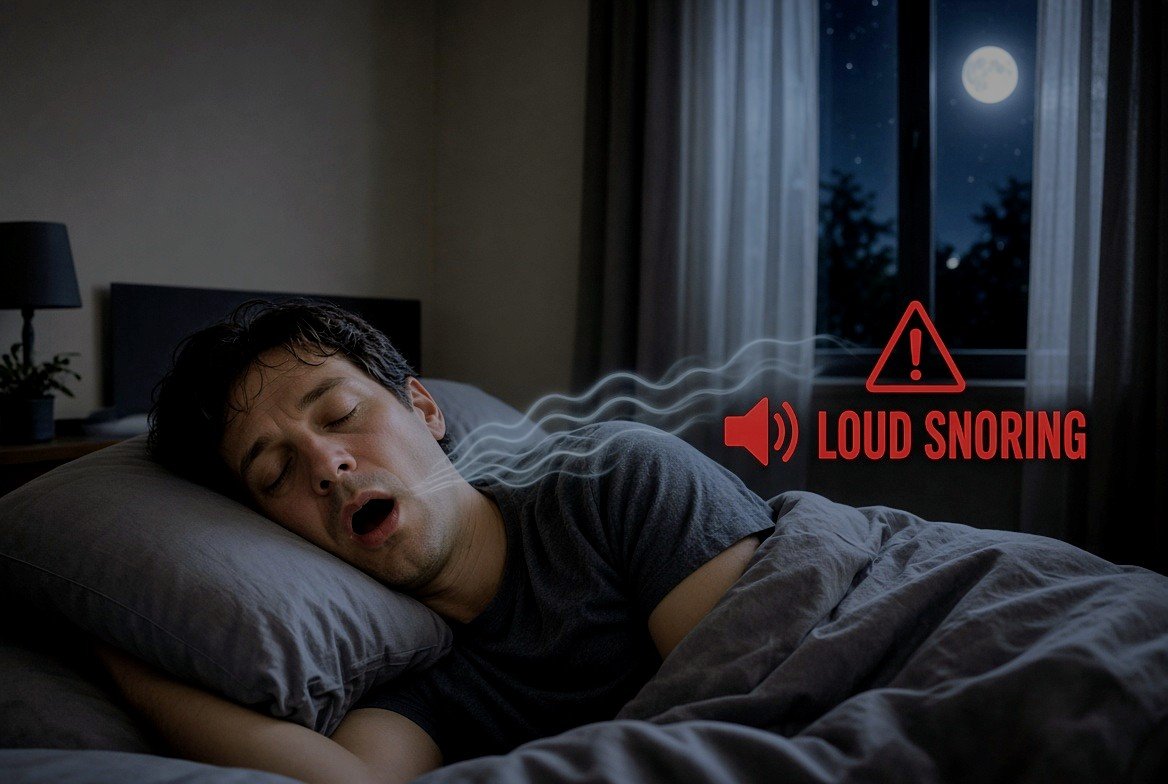
If your partner has started nudging you awake, or you’ve woken yourself up mid-snore, you’re probably wondering if this is just annoying or something more. Loud snoring at night is extremely common, and most of the time it’s not dangerous [6].
But certain patterns — like gasping, choking, or long breathing pauses — can point to something that deserves a closer look. Here’s how to tell the difference, and what steps are safe to try in the meantime.
Key Takeaways
- Snoring alone rarely means sleep apnea — the pattern and other symptoms matter more than volume.
- Gasping, choking, or witnessed breathing pauses are signs worth discussing with a doctor.
- Simple habits like side-sleeping may reduce snoring for some people, though results vary.
- Viral fixes like mouth taping aren’t universal solutions and can be unsafe for some people.
- A sleep study, whether at home or in a lab, can clarify what’s actually happening at night.
Quick Answer
Loud snoring is noisy breathing caused by vibration of relaxed tissues in the upper airway during sleep. It’s common and doesn’t automatically mean sleep apnea, but snoring paired with gasping, choking, breathing pauses, or severe daytime sleepiness should be discussed with a healthcare professional [1][4].
Is loud snoring always a medical problem?
Not necessarily. Plenty of people snore occasionally — during a cold, after a few drinks, or when they’re overly tired — without any underlying breathing disorder [6].
What matters more is whether the snoring is habitual, disruptive, and paired with other symptoms like choking sounds or long pauses in breathing.
Why the volume alone is not enough
A loud snore doesn’t tell you much about severity on its own. The National Heart, Lung, and Blood Institute notes that sleep apnea is defined by repeated pauses in breathing, not by how loud someone snores [1].
Two people can snore at similar volumes — one may have ordinary snoring, the other might have obstructive sleep apnea. The pattern and accompanying symptoms are what count.
Quick Wins
- Notice whether snoring is worse when you sleep on your back.
- Ask if you’ve had anything alcoholic within a few hours of bedtime.
- Check whether nasal congestion has been an issue lately.
- Ask a partner if they’ve ever heard you stop breathing, even briefly.
What Causes Loud Snoring?
Several factors can contribute to snoring, and often more than one is at play.
Relaxed throat tissues. During deep sleep, muscles in the throat and soft palate relax. If they relax too much, they can vibrate as air passes by, creating the snoring sound [6].
Sleeping on the back. Gravity can cause the tongue and soft tissues to fall backward, narrowing the airway [7].
Nasal congestion or obstruction. A stuffy nose from allergies or a cold forces you to breathe through your mouth, which may worsen snoring [6][7].
Alcohol near bedtime. Alcohol relaxes muscles, including those in the throat, which can make snoring louder or more frequent for some people [7].
Weight and airway anatomy. Extra tissue around the neck and throat may narrow the airway, though snoring can happen at any body size [4][6].
Irregular sleep or sleep deprivation. Overtiredness can cause deeper muscle relaxation during sleep, which may contribute to snoring [7].
These factors may contribute individually or together — there’s rarely one single cause.
Loud Snoring vs. Possible Sleep Apnea
This table can help you think through your own pattern, though it’s not a diagnostic tool.
| Pattern | What It May Suggest | Recommended Action |
|---|---|---|
| Occasional snoring during congestion | Temporary airway narrowing | Review symptoms and environment |
| Regular loud snoring | Ongoing airway vibration | Discuss if persistent or disruptive |
| Snoring with gasping or choking | Possible breathing disruption | Seek clinical evaluation |
| Witnessed breathing pauses | Possible sleep-disordered breathing | Speak with a clinician |
| Snoring plus severe daytime sleepiness | Possible sleep disorder | Seek medical advice |
| Snoring with no other symptoms | May be ordinary snoring | Monitor and review practical factors |
Important: Loud snoring alone cannot diagnose sleep apnea. Only a clinical evaluation, and often a sleep study, can confirm it [2][5].
Warning Signs That Need Attention
Some symptoms are worth flagging to a primary care physician, especially if they show up alongside snoring:
- Gasping or choking sounds during sleep
- Breathing pauses noticed by a partner
- Morning headaches
- Dry mouth upon waking
- Severe daytime sleepiness
- Trouble concentrating during the day
- High blood pressure or related health concerns
These symptoms can have more than one cause, so they’re a reason to check in with a doctor rather than a reason to panic [1][4].
Did You Know? According to the American Academy of Sleep Medicine, obstructive sleep apnea involves repeated episodes of partial or complete airway blockage during sleep — a pattern distinct from ordinary snoring [2].
What You Can Try Safely
A few everyday changes may ease mild snoring for some people. Results vary, and none of these replace a medical evaluation if warning signs are present.
Sleep on your side. This may reduce snoring for people whose symptoms are worse when lying on their back [7].
Treat nasal congestion appropriately. Short-term use of saline rinses or as-needed remedies may help, but long-term decongestant use should be discussed with a clinician first.
Avoid alcohol close to bedtime. Since alcohol can relax airway tissues, skipping it in the hours before sleep may reduce snoring intensity for some people [7].
Maintain a regular sleep schedule. Chronic sleep deprivation can worsen snoring in some people, so consistent bed and wake times may help.
Improve the bedroom environment. A cool, quiet, comfortable bedroom supports better overall sleep quality.
Review weight-related advice carefully. Weight can be one factor among several, but it’s not the only cause of snoring, and weight loss isn’t a guaranteed fix for everyone [4][6].
Be Cautious With Viral Anti-Snoring Hacks
Social media is full of snoring “hacks.” Some are harmless; others carry real risks.
Mouth taping. This trend involves taping the mouth shut to encourage nasal breathing. It isn’t a universal solution and may be unsafe for people with nasal obstruction, breathing problems, vomiting risk, or suspected sleep apnea — talk to a doctor before trying it.
Chin straps and nasal devices. These products vary widely, and none of them address an underlying airway obstruction the way a proper evaluation and treatment plan can [9].
Supplements and essential oils. These are not proven treatments for snoring or sleep apnea, and effectiveness isn’t well supported by evidence.
Sleep trackers and snoring apps. These tools may record sound or estimate patterns, but they cannot diagnose sleep apnea [9]. Understanding what sleep trackers can and cannot detect can help set realistic expectations before relying on one.
Warning: Do not use mouth taping or over-the-counter devices as a substitute for medical evaluation if you have gasping, choking, or witnessed breathing pauses.
When to Ask About a Sleep Study
At-home sleep apnea test. For some adults, a home sleep apnea test can be a starting point, especially when symptoms are fairly clear-cut. Learning more about at-home sleep apnea testing can help you know what to expect.
Sleep-lab study. A more comprehensive, in-lab study may be recommended if symptoms are complex, or if a home test result is negative but symptoms continue [10].
What to tell your doctor. Before your appointment, it helps to track:
- How often the snoring happens
- Whether a partner has noticed gasping or pauses
- Daytime sleepiness levels
- Alcohol or medication timing near bedtime
- Nasal congestion patterns
- Usual sleep position
How a Partner Can Help Without Blame
Use neutral language. Try “I’ve noticed you gasp sometimes” rather than framing it as a complaint. It keeps the conversation focused on health, not annoyance.
Record symptoms responsibly. A short audio or video clip can help describe the pattern to a doctor, though it’s not a diagnostic test on its own.
Protect both people’s sleep. Temporary adjustments, like separate sleeping arrangements for a few nights, can buy time while an evaluation is arranged — this isn’t a long-term fix, just a stopgap.
When to See a Doctor
Talk to a primary care physician about habitual loud snoring if you notice:
- Gasping or choking during sleep
- Breathing pauses witnessed by a partner
- Severe daytime sleepiness
- Morning headaches
- Repeated nighttime awakenings
- High blood pressure concerns
- Falling asleep while driving or during daily activities
A doctor can help determine whether further testing, like a sleep study, makes sense for your situation [1][2].
When to Seek Urgent Help (Call 911)
Call 911 for severe breathing difficulty, chest pain, fainting, or sudden neurological symptoms like slurred speech or weakness on one side of the body. These are medical emergencies unrelated to ordinary snoring, and they need immediate attention.
Loud snoring by itself is not a reason to call 911.
Summary
- Loud snoring is common and usually not dangerous on its own, but certain patterns deserve medical attention.
- Gasping, choking, witnessed breathing pauses, and severe daytime sleepiness are the clearest warning signs.
- Safe first steps include side-sleeping, limiting alcohol before bed, and improving sleep habits.
- Viral fixes like mouth taping aren’t right for everyone — check with a doctor if you have nasal or breathing concerns.
- A home or in-lab sleep study can offer clarity when symptoms persist or seem complex.
FAQs
Is loud snoring every night normal?
Frequent snoring is common, but it’s worth mentioning to a doctor if it’s paired with gasping, choking, or noticeable daytime sleepiness. On its own, occasional loud snoring usually isn’t a medical emergency.
Does loud snoring always mean sleep apnea?
No. Many people snore loudly without having sleep apnea. The difference usually comes down to whether there are breathing pauses, gasping, or significant daytime symptoms alongside the snoring [1][4].
How can I stop snoring naturally?
Side-sleeping, limiting alcohol before bed, treating nasal congestion, and keeping a consistent sleep schedule may help some people. Results vary, and these habits don’t address sleep apnea if that’s the underlying cause.
Can a sleep tracker diagnose sleep apnea?
No. Sleep trackers and snoring apps can record sound or estimate movement patterns, but they cannot diagnose sleep apnea [9]. A clinical evaluation or sleep study is needed for an actual diagnosis.
Should I get a sleep study for snoring?
If you have warning signs like gasping, witnessed breathing pauses, or severe daytime sleepiness, talking to a doctor about a sleep study is a reasonable next step [10]. Without those symptoms, a study may not be necessary right away.
What’s the difference between snoring and sleep apnea?
Snoring is the sound caused by vibrating airway tissue during sleep. Sleep apnea involves repeated pauses in breathing, which can lower oxygen levels and disrupt sleep more seriously [1][2].
References
- NHLBI: Sleep Apnea
- AASM: Sleep Apnea Information
- MedlinePlus: Sleep Apnea
- Mayo Clinic: Obstructive Sleep Apnea — Symptoms and Causes
- Mayo Clinic: Obstructive Sleep Apnea — Diagnosis and Treatment
- Cleveland Clinic: Snoring
- Sleep Foundation: Snoring
- NHS: Snoring
- FDA: Sleep Apnea Devices
- AASM: Clinical Practice Guideline for Diagnostic Testing for Adult Obstructive Sleep Apnea
Educational disclaimer: This article is for educational purposes only and is not medical advice. It does not diagnose or treat sleep apnea or any other condition. For personal care, talk to your primary care physician. Call 911 for emergencies.