

You’re asleep. Then you’re not. The room is dark, the house is quiet, and the clock reads 3 a.m. — again.
If you wake up at 3 a.m. every night and can’t get back to sleep, you’re not alone, and you’re almost certainly not experiencing something mystical or medically dramatic. There are real, practical reasons this happens, and several of them are within your control.
This guide explains what’s most likely going on, what to do right now, and when the pattern deserves a closer look from a clinician.
Key Takeaways
- 3 a.m. is not a medical diagnosis — waking at a consistent time is often a normal pattern tied to sleep cycles and habit.
- Common contributors include stress, alcohol, noise, and bathroom needs — not a cortisol disorder or “organ clock.”
- What you do when you wake matters — clock-watching makes things worse; quiet, dim activity may help.
- Persistent awakenings deserve medical attention — especially with snoring, gasping, pain, or mood changes.
- A simple sleep diary can help a clinician understand the pattern faster.
Wake Up at 3 a.m. Every Night:
Waking up at 3 a.m. every night can happen because of normal lighter sleep, stress, alcohol, caffeine, noise, temperature, bathroom needs, or an underlying sleep or health problem. The time itself is not usually a diagnosis, but persistent awakenings that affect daytime function deserve medical attention [1][3].
Is 3 a.m. a medically special time?
No. The exact hour isn’t what matters. If you consistently go to sleep around 10 or 11 p.m., your body may naturally cycle into a lighter stage of sleep around 3 to 4 a.m. — and during lighter sleep, ordinary disturbances that wouldn’t wake you earlier in the night can suddenly feel significant.
Why the pattern can feel so consistent
Here’s something worth knowing: repeated awakenings can become learned behavior. When the brain begins associating a specific time or the bedroom environment with wakefulness, it can start anticipating that alertness — reinforcing the pattern even without an obvious physical trigger [3].
Did You Know? A repeated awakening can become a conditioned pattern when the brain begins associating a time or the bedroom with alertness [3].
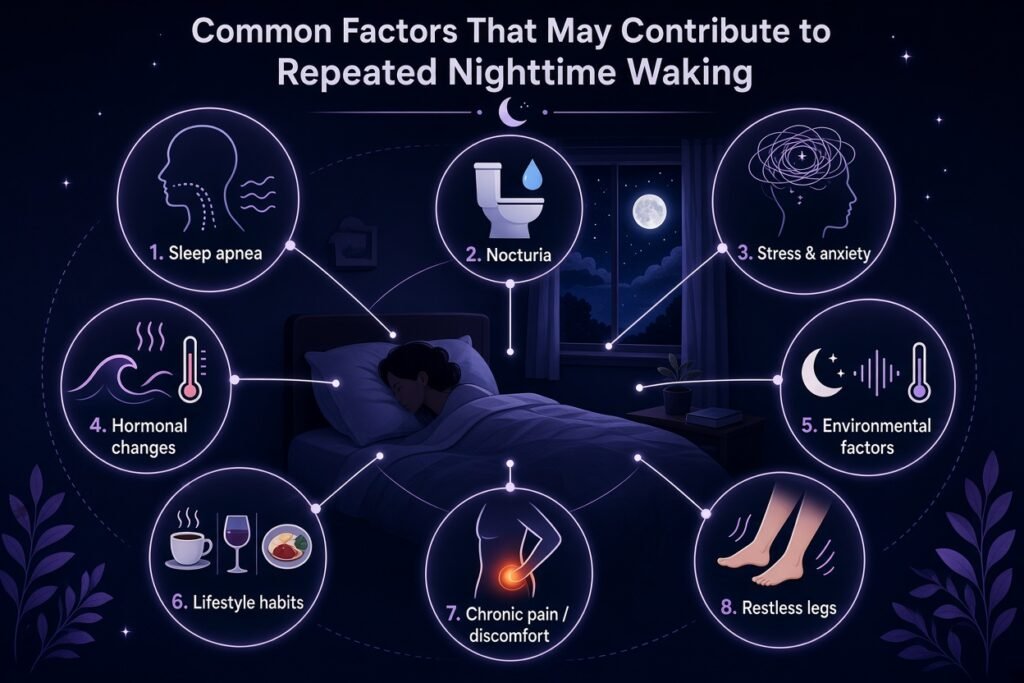
Common Reasons You May Wake Up at 3 a.m.
A normal lighter sleep period
Sleep cycles are not identical 90-minute blocks for every person on every night. Sleep naturally becomes lighter toward the second half of the night, and brief awakenings — most of which people don’t remember — are common [2][7].
Stress or a racing mind
Anxiety, worry, or unresolved daytime stress can make it much harder to return to sleep after a normal awakening. The mind that was quiet at 10 p.m. may have a lot more to say at 3 a.m. See our guide on nighttime anxiety and racing thoughts for more on this.
Alcohol or late caffeine
Alcohol may promote initial sleepiness but can disrupt sleep in the second half of the night once the body begins processing it [3]. Caffeine sensitivity and timing vary from person to person — what’s fine for one person at 4 p.m. keeps another person alert at midnight.
Noise, light, temperature, or a partner
A partner’s snoring, a garbage truck, streetlight through thin curtains, or a room that’s too warm can all trigger an awakening that then feels impossible to shake. For practical environment changes, see our guide on comfortable sleep environment.
Bathroom needs or evening fluids
Needing to urinate at night — sometimes called nocturia — is common in adults of various ages and can result from fluid timing, caffeine, alcohol, medications, or underlying conditions worth discussing with a clinician.
Reflux, discomfort, or pain
Acid reflux, back pain, joint pain, or general physical discomfort can surface during lighter sleep periods when the brain is more receptive to physical signals [2].
Night-shift work or irregular schedules
An inconsistent sleep-wake schedule can disrupt circadian rhythm — the body’s internal clock — making predictable sleep harder. For more, see our guide on irregular work schedules and sleep.
Snoring or breathing disturbances
If you’re waking up gasping, choking, or with a significant sense of air hunger, that’s worth taking seriously. These patterns can be associated with obstructive sleep apnea and deserve clinical evaluation, not just a lifestyle tweak [8].
| Possible Contributor | Clue | Practical First Step |
|---|---|---|
| Stress | Racing thoughts, worrying | Write worries down earlier in the evening |
| Alcohol | Sleepier initially, restless later | Review timing and amount |
| Bedroom disturbance | Noise, light, heat | Improve the sleep environment |
| Bathroom needs | Repeated nighttime urination | Review evening fluids; see a clinician if persistent |
| Sleep apnea | Snoring, gasping, daytime sleepiness | Speak with a clinician |
| Pain or reflux | Waking with discomfort | Discuss with a healthcare professional |
What the “3 a.m. Cortisol” Claim Gets Wrong
You’ve probably seen it: some article or video claiming that waking at exactly 3 a.m. means your cortisol is surging, your liver is struggling, or your body is “detoxing.”
The body clock is real — the exact hour is not universal
Circadian rhythms are genuine and well-studied [7]. But the idea that 3 a.m. is a universal, fixed window for cortisol activity, liver function, or organ cleansing isn’t supported by reliable evidence. The body clock varies by sleep timing, light exposure, work schedule, age, and individual biology.
Avoid organ-clock explanations
Claims about waking at 3 a.m. proving liver problems, toxin buildup, or a cortisol disorder are not reliable diagnostic explanations. If you’re concerned about cortisol, liver function, or a hormonal condition, a blood test ordered by a physician is the appropriate evaluation — not a clock reading [3].
Important: Waking at 3 a.m. does not automatically mean a cortisol problem, a liver issue, or any other specific condition.
What to Do When You Wake Up
This is where most people make it harder for themselves without realizing it.
Do not check the clock repeatedly
Seeing the time — especially if you then calculate how many hours of sleep remain — increases frustration and mental alertness. Mayo Clinic recommends keeping clocks out of direct view [1].
Quick Win: Move the clock out of direct view tonight. This one change can reduce the spiral of clock-watching that keeps people awake longer.
Keep lights low
Avoid turning on bright overhead lights. Bright light signals the brain that daytime has arrived [1].
Try quiet relaxation
You don’t need to fall asleep immediately — you need your body to stay calm. Try:
- Slow, natural breathing.
- A gentle body scan from head to toe.
- Reading a printed book (boring enough to make you sleepy).
- Soft, familiar audio.
- Progressive muscle relaxation — tensing and releasing muscle groups slowly.
Leave bed if you remain awake
If you’re still awake after roughly 20 minutes, get up. Go to a dimly lit room and do something quiet — not work, not your phone, not anything stimulating. Return to bed when you actually feel sleepy. This approach is consistent with stimulus-control guidance from Mayo Clinic and AASM [1][5].
How to Reduce Repeated Awakenings
Keep a stable wake time
Waking at the same time every day — including weekends — helps anchor the sleep-wake cycle [5].
Use a consistent wind-down routine
A predictable evening signal helps the brain begin transitioning toward sleep before you even get into bed. See our guide on consistent sleep and wake routine.
Review caffeine and alcohol timing
These are two of the most common modifiable contributors to middle-of-the-night waking [3].
Keep the bedroom comfortable
Temperature, noise level, light exposure, and overall comfort all matter in ways that may seem minor but add up significantly overnight.
Avoid long or late naps
A nap after mid-afternoon can reduce sleep pressure — the buildup of sleepiness that drives you to sleep and keeps you asleep [5].
Get regular daytime activity
Physical activity may support sleep quality for many adults. Avoid intense exercise immediately before bed if that disrupts your sleep specifically [1]
Track Patterns for One to Two Weeks
A simple sleep diary gives both you and a clinician much more useful information than a vague description of “waking up a lot.”
Record each day:
- Bedtime.
- Estimated time it took to fall asleep.
- Wake-ups — how many, how long.
- Caffeine and alcohol — timing and amount.
- Evening meal timing.
- Stress level that day.
- Bedroom temperature and any disturbances.
- Daytime sleepiness.
Avoid turning this into an obsessive hourly log — a simple daily note is enough.
When It May Be a Medical Issue
Sleep apnea clues
Talk to a clinician if you notice — or a partner reports — any of the following:
- Loud, frequent snoring.
- Gasping or choking sounds during sleep.
- Witnessed breathing pauses.
- Morning headaches.
- Significant daytime sleepiness despite adequate sleep time [8].
Warning: Do not self-diagnose sleep apnea from one symptom or one wearable reading. A clinician-ordered evaluation is the appropriate next step.
Reflux, pain, or urinary symptoms
Persistent heartburn, joint pain, or nighttime urination that disrupts sleep regularly are all worth discussing with a primary care physician.
Mood and anxiety symptoms
If early waking comes alongside persistent low mood, loss of interest, hopelessness, or severe anxiety, professional support is important — these patterns can be associated with depression or anxiety disorders [4]
Medication or substance effects
Some prescription medications, supplements, nicotine, alcohol, and even herbal products can affect sleep architecture. Do not stop a prescribed medication without medical advice — instead, raise the concern with the prescribing clinician.
When to See a Doctor
Talk with your primary care physician if:
- The pattern continues for several weeks.
- You feel sleepy or have trouble concentrating during the day as a result.
- You regularly cannot fall back asleep after waking.
- Loud snoring, gasping, or choking occurs during sleep.
- You’re experiencing significant pain, reflux, sweating, or urinary disruption at night.
- You’re falling asleep while driving or at work.
- Mood symptoms are worsening alongside the waking pattern.
When to Seek Urgent Help
Call 911 for chest pain, severe breathing difficulty, fainting, sudden neurological symptoms such as confusion or weakness, or any medical emergency.
If someone is experiencing thoughts of self-harm or suicide, contact the 988 Suicide & Crisis Lifeline by calling or texting 988 (US). Emergency services are also available at 911.
Summary
- Try the practical steps tonight — clock out of view, dim light, quiet activity if needed, consistent wake time tomorrow.
- Don’t accept the cortisol or organ-clock explanation — those claims aren’t supported by reliable evidence.
- Keep a simple two-week sleep diary before or alongside seeing a clinician — it gives the conversation a much stronger foundation.
- See a doctor if awakenings persist for weeks, affect your daytime function, or come with snoring, gasping, pain, or mood changes.
- Act quickly on urgent symptoms — chest pain, breathing difficulty, or thoughts of self-harm need immediate help.
FAQs
Why do I wake up at exactly 3 a.m.?
There’s no medically fixed significance to 3 a.m. specifically. If you go to sleep around 10 or 11 p.m., you may naturally reach a lighter sleep stage around that hour — and during lighter sleep, small disturbances are more likely to wake you. Repeated waking can also become a conditioned pattern over time [1][3].
How can I stop waking up at 3 a.m. every night?
Start with the most common modifiable factors: review caffeine and alcohol timing, keep a consistent wake time, improve the bedroom environment, and avoid clock-watching when you wake. If those changes don’t help within a few weeks, talk to a primary care physician [1][5].
Is waking up at 3 a.m. a sign of anxiety?
It can be. Stress and anxiety can make it harder to return to sleep after a normal lighter-sleep awakening. If racing thoughts are consistently the problem, strategies for managing nighttime worry — and, if needed, professional support — may help more than sleep-specific tips alone [4].
Does waking up at 3 a.m. mean I have insomnia?
Not necessarily. Occasional nighttime waking is normal. Sleep maintenance insomnia — difficulty staying asleep — is a clinical pattern defined partly by how often it happens and how much it affects daytime functioning [7][9]. A clinician can help determine whether the pattern meets clinical criteria.
Can sleep apnea cause me to wake up at 3 a.m.?
Yes, sleep-disordered breathing can cause nighttime awakenings at various times. If waking is accompanied by snoring, gasping, choking, morning headaches, or significant daytime sleepiness, that combination warrants a clinical evaluation rather than self-treatment [8].
Is the 3 a.m. cortisol theory true?
No reliable clinical evidence supports the idea that waking at 3 a.m. is caused by a cortisol surge or that it proves liver problems or other organ dysfunction. While the body’s hormonal rhythms are real, the specific “3 a.m. cortisol spike” claim is not a sound basis for self-diagnosis [3].
References
- Mayo Clinic: Insomnia — How Do I Stay Asleep?
- Mayo Clinic: Sleep Disorders — Symptoms and Causes
- Cleveland Clinic: Why You Keep Waking Up at 3 a.m.
- Cleveland Clinic: Sleep Anxiety
- AASM: Insomnia Fact Sheet
- AASM: Practice Guidelines
- NHLBI: Insomnia
- NHLBI: Sleep Apnea
- MedlinePlus: Insomnia
Educational Disclaimer
This article provides general information about nighttime waking and does not diagnose insomnia, sleep apnea, anxiety, depression, reflux, or any other health condition. Speak with a qualified healthcare professional if awakenings persist, affect daytime functioning, or occur with loud snoring, gasping, pain, or other concerning symptoms.
This article is for educational purposes only and is not medical advice. For personal care, talk to your primary care physician. Call 911 for emergencies.