
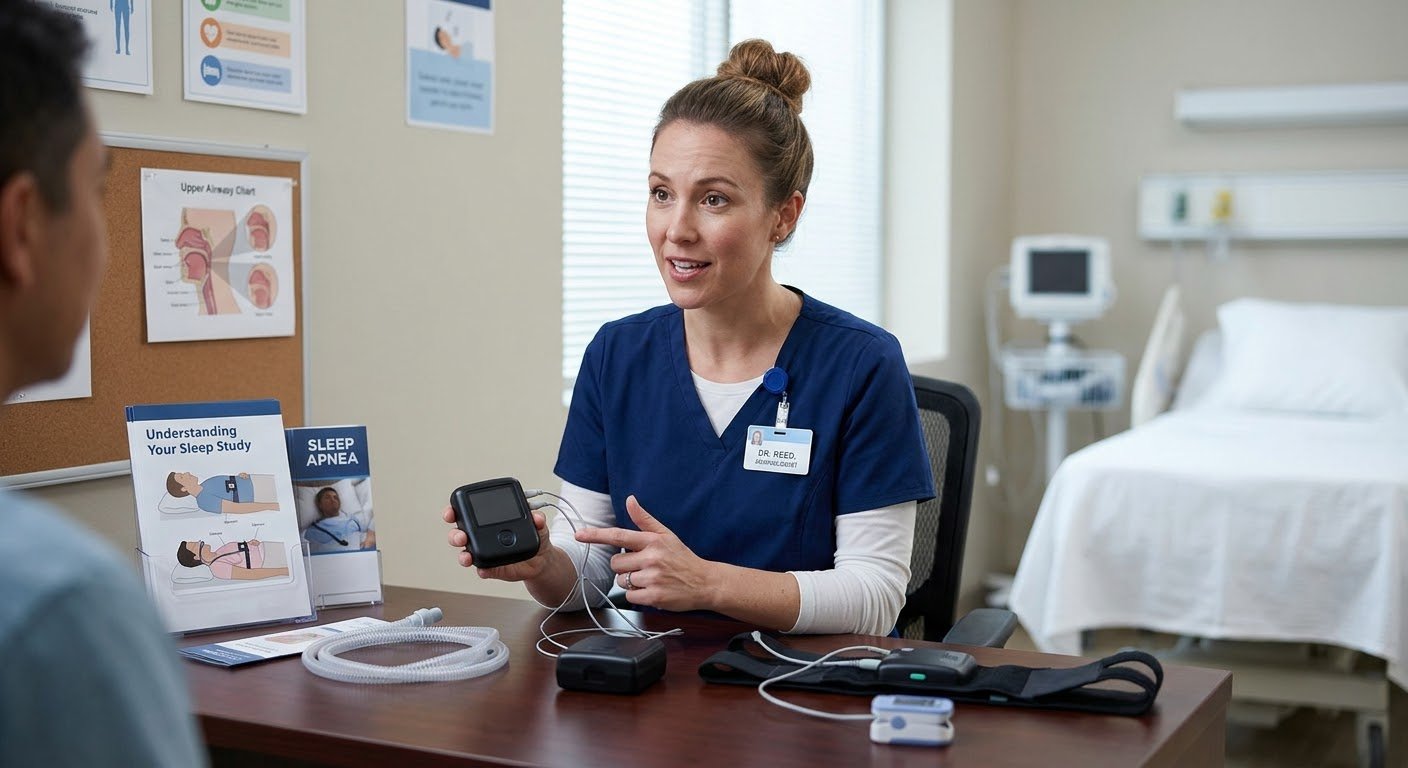
If you’ve been wondering how to test for sleep apnea, the short answer is that it starts with a conversation, not a gadget. Loud snoring, gasping at night, or daytime exhaustion can all point toward sleep apnea, but none of those signs can confirm it on their own. A proper evaluation usually involves a healthcare provider, followed by either a home sleep apnea test or an overnight study at a sleep lab. This guide walks through how that process actually works, who typically qualifies for home testing, and what happens if your results come back unclear.
Quick Answer: Sleep apnea testing starts with a clinical evaluation. From there, a healthcare provider may recommend a home sleep apnea test for selected adults or an in-lab overnight sleep study for more complex cases. Symptoms and consumer devices can raise suspicion, but a diagnosis requires a test interpreted by a qualified clinician [1].
Key Takeaways
- Testing starts with a clinician, not a device — symptoms alone can’t confirm sleep apnea.
- Home tests work for selected adults with suspected uncomplicated obstructive sleep apnea, not everyone [3].
- Lab studies offer a fuller picture, including brain-wave monitoring, and are often better for complex health situations.
- A negative home test isn’t the final word — guidelines often call for a follow-up lab study if results are negative, inconclusive, or technically inadequate [3].
- Wearables and apps can flag concerns but cannot replace a clinically interpreted sleep study.
Quick Answer: How Is Sleep Apnea Tested?
Evaluation for suspected sleep apnea typically begins with a healthcare professional reviewing your symptoms, health history, and risk factors. From there, testing may involve an overnight laboratory sleep study or a home sleep apnea test for appropriate candidates [1]. The test itself — not the symptoms leading up to it — is what helps establish a diagnosis.
Quick Wins Before Your Appointment
A little preparation can make your first appointment far more productive. Try these before you go in:
- Write down your symptoms and how often they happen — snoring, choking sensations, morning headaches, or daytime drowsiness.
- Ask a partner or family member about observed breathing pauses or gasping, since these often happen while you’re asleep and unaware.
- List your medicines, supplements, and relevant health conditions, including heart or lung issues.
- Keep a simple sleep diary tracking bedtime, wake time, and how sleepy you feel during the day — NHLBI notes this kind of record can support the diagnostic conversation [1].
Quick Win: Bring a short sleep diary and any partner observations to your appointment — it often speeds up the next steps.
Who Should You Contact About Possible Sleep Apnea?
Start with a primary-care clinician or a sleep specialist. Either one can evaluate your symptoms and decide what kind of testing, if any, makes sense for your situation.
Explain both nighttime and daytime symptoms clearly. Loud snoring matters, but so does how tired you feel at work, whether you’ve dozed off while driving, or whether you wake up with a dry mouth or headache.
Don’t diagnose yourself from snoring alone. Plenty of people snore without having sleep apnea, and some people with sleep apnea don’t snore loudly at all. Access to testing, referral requirements, and insurance coverage can vary a good deal depending on where you live and your specific health plan, so it’s worth asking your provider directly what the process looks like for you.
Important: Symptoms can suggest sleep apnea, but they cannot confirm it. Only a clinically interpreted test can do that [1][3].
How to Test for Sleep Apnea: Home Test vs. Laboratory Study
Once a clinician decides testing is appropriate, there are generally two paths: a home sleep apnea test or an in-lab polysomnography study. They’re not interchangeable, and the right choice depends on your health profile.
| Feature | Home Sleep Apnea Test | Laboratory Polysomnography |
|---|---|---|
| Setting | Your own home | Sleep center or laboratory |
| Typical measurements | Airflow, breathing effort, oxygen levels, and other signals depending on the device | Brain activity, breathing, oxygen levels, heart activity, body movements, and more |
| Sleep stages | Many conventional home devices don’t directly measure sleep stages | Can assess sleep stages through brain-wave monitoring |
| Typical candidates | Selected uncomplicated adults with suspected obstructive sleep apnea | More complex cases or when a fuller assessment is needed |
| Main limitation | Can miss cases or produce an inadequate recording | Requires more equipment and an unfamiliar sleep setting |
| Who interprets it | A qualified clinician | A qualified clinician |
Who may be suitable for home testing? The American Academy of Sleep Medicine supports technically adequate home testing for uncomplicated adults showing signs of moderate-to-severe obstructive sleep apnea risk [3]. It isn’t meant as a general screening tool for anyone curious about their sleep — a clinical evaluation comes first.
When might a lab study be the better option? Certain situations often call for in-lab testing instead, including significant heart or lung conditions, suspected hypoventilation or certain neuromuscular conditions, chronic opioid use, severe insomnia, or a home test that came back negative, inconclusive, or technically inadequate [3]. These are examples of clinical considerations your provider will weigh — not a checklist for choosing your own test.
Preparing for and Completing Your Sleep Test
Follow the testing center’s specific instructions. Every provider and device setup can differ slightly, so their guidance takes priority over general tips.
Ask about your usual medicines rather than stopping them on your own. Some medications may affect results, but a clinician should guide any changes, not a generic article.
Check sensor setup and know the equipment-return process if you’re doing a home test, and ask in advance whom to contact if something isn’t working properly overnight.
During the test itself, a home sleep apnea test usually means applying a few supplied sensors — often around the chest, finger, and nose — before going to sleep as you normally would. A lab study involves similar monitoring but takes place overnight at a sleep center, with staff tracking the signals in real time. It’s painless, even though the setup can feel unfamiliar at first [2]. If you sleep poorly or a sensor comes loose, don’t try to judge for yourself whether the recording is still valid — just report it to your provider and let them determine the next step.
Tip: Ask who will review the recording — not just how quickly an automated report shows up.
What Happens After the Results
A clinician first checks whether the recording was adequate. A technically poor recording may need to be repeated or followed by a different type of test.
Results are considered alongside your symptoms and medical history, not viewed in isolation. A number on a report doesn’t tell the whole story by itself.
What If a Home Test Is Negative? This is where some people assume they’re in the clear — but that’s not necessarily true. Guidelines call for a follow-up laboratory sleep study when a single home sleep apnea test is negative, inconclusive, or technically inadequate during the evaluation of suspected obstructive sleep apnea [3]. A negative home result doesn’t automatically rule out sleep apnea, especially if symptoms continue. If you’re still feeling unusually tired despite normal rest, it may help to look into other possible causes of persistent tiredness despite enough time in bed, since fatigue has more than one potential source.
Warning: A negative home test does not automatically end the evaluation. Follow up with your provider if symptoms continue [3].
Can an App or Smartwatch Replace a Sleep Apnea Test?
A consumer recording is not the same as a diagnostic sleep study. Smartwatches, rings, and phone apps can track things like movement, heart rate, or estimated oxygen levels, but that data isn’t the same as a clinically validated test. If you’re curious how reliable these tools generally are, it’s worth understanding wearable estimates versus clinical testing before leaning on one for anything diagnostic.
Not every wearable has the same regulatory status, so one device’s “sleep apnea detection” feature may work very differently from another’s.
Report concerning findings without self-diagnosing. If your watch flags frequent low oxygen readings, that’s worth mentioning to a provider — but it’s a prompt for a conversation, not a diagnosis. Questionnaires and symptom checklists alone aren’t sufficient to diagnose obstructive sleep apnea either [1][3].
When to See a Doctor
Consider reaching out to a healthcare provider if you notice:
- Loud, frequent snoring with breathing pauses or gasping reported by someone who sleeps near you
- Regular daytime sleepiness, even after what seems like a full night’s sleep
- Morning headaches or a dry mouth that happens often
- Difficulty concentrating, mood changes, or persistent tiredness that doesn’t have an obvious cause
- High blood pressure that’s difficult to manage, since it sometimes overlaps with sleep-related breathing problems
When to Seek Urgent Help (Call 911)
Sleep apnea testing itself is not an emergency process, but certain symptoms need immediate medical attention rather than a routine appointment. Call 911 or seek emergency care right away for chest pain, severe shortness of breath, confusion, bluish lips or face, or any sign of a possible heart or breathing emergency — regardless of whether sleep apnea is suspected.
Questions to Ask Before and After Testing
A short list of questions can help you get more out of the process:
- Why is this particular test appropriate for me?
- What exactly does this device measure?
- Who will interpret my results?
- What should I do if the equipment fails overnight?
- What happens next if my result is negative?
- Could another sleep problem explain my symptoms instead?
- What costs and insurance coverage should I confirm beforehand?
Frequently Asked Questions
How do I get tested for sleep apnea?
Testing usually starts with an appointment with a primary-care provider or sleep specialist, who reviews your symptoms and health history. From there, they may recommend a home sleep apnea test or a laboratory sleep study depending on your situation [1].
Can I test myself for sleep apnea at home?
A clinician-ordered home sleep apnea test is possible for selected adults with suspected uncomplicated obstructive sleep apnea, but it still requires a professional evaluation beforehand and interpretation afterward [3]. It isn’t the same as a general self-screening tool.
Is a home test as comprehensive as a laboratory study?
Not quite. Home tests typically measure airflow, breathing effort, and oxygen levels, while lab studies can also track brain activity and sleep stages through EEG monitoring, offering a fuller picture for more complex cases [3].
What happens if my home test is negative?
A negative home test doesn’t necessarily rule out sleep apnea. Guidelines often recommend a follow-up laboratory sleep study if the home test is negative, inconclusive, or technically inadequate [3].
Can a smartwatch or oxygen monitor replace a sleep study?
No. These devices can provide general wellness data and may flag potential concerns, but they are not a substitute for a clinically interpreted diagnostic sleep study [1][3].
Do I need a referral for sleep apnea testing?
This depends on your healthcare provider and insurance plan, so requirements vary by situation. It’s best to ask your primary-care provider directly about the process where you live.
Summary
- A sleep apnea diagnosis requires a clinical evaluation plus a properly interpreted test — symptoms and devices alone aren’t enough.
- Home sleep apnea tests may suit selected adults with suspected uncomplicated obstructive sleep apnea.
- Laboratory sleep studies offer more comprehensive monitoring and may be recommended for more complex health situations.
- A negative home test often calls for follow-up testing rather than automatic reassurance.
- Wearables and apps can be useful for noticing patterns, but they can’t replace a clinically reviewed sleep study.
Educational Disclaimer
This article is for general educational purposes and does not diagnose, treat, or rule out sleep apnea or any other condition. It is not a substitute for personalized medical advice. Talk with a qualified healthcare provider about your symptoms and testing options. If you experience chest pain, severe shortness of breath, confusion, or bluish lips or face, call 911 or seek emergency care immediately. If you or someone you know is in emotional distress or crisis, the 988 Suicide & Crisis Lifeline is available by call or text, 24/7.