
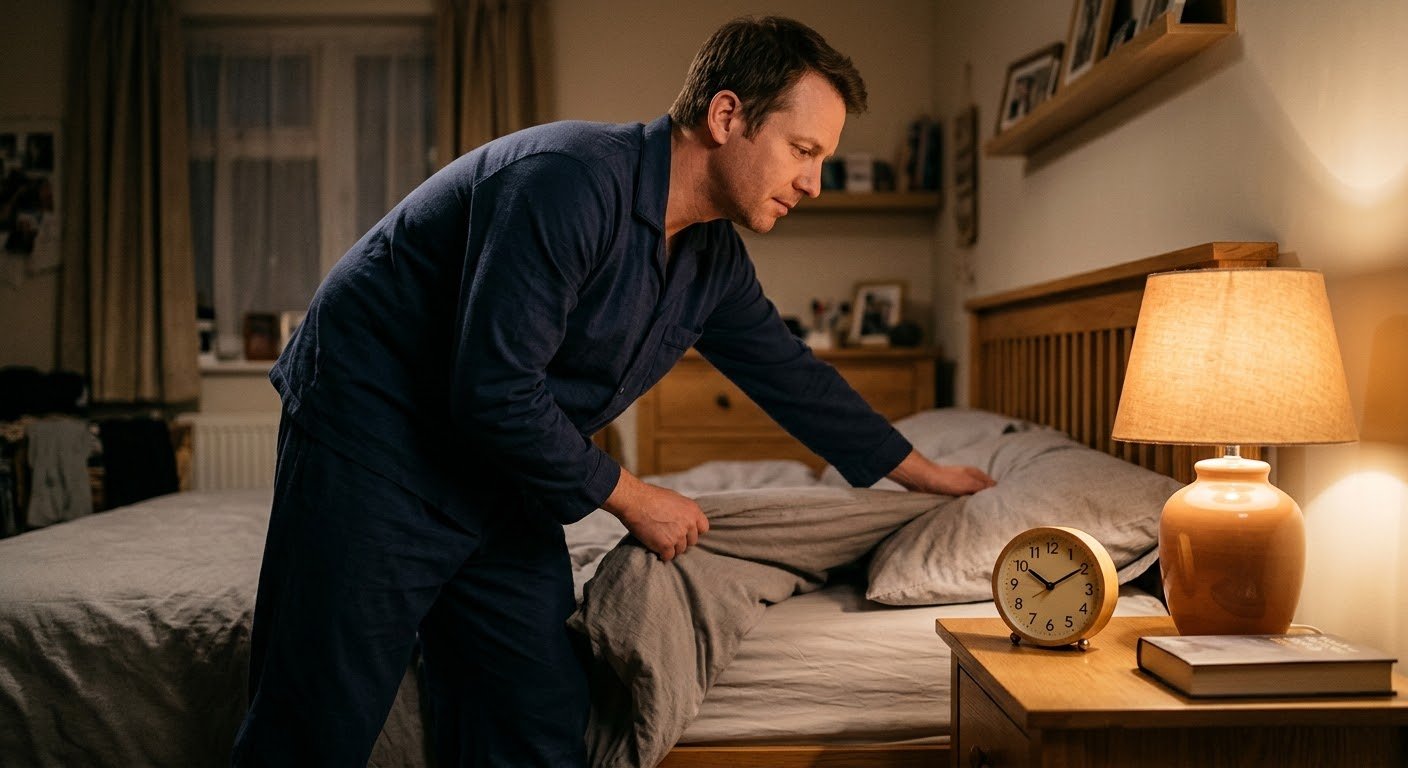
The clocks are about to fall back, and if you’re trying to figure out how to adjust to daylight saving time without feeling foggy for a week afterward, you’re asking the right question. Places in the United Kingdom move clocks back on October 25, and most U.S. locations that observe daylight saving time follow on November 1, 2026. Gaining an hour sounds like a gift, but your body’s internal clock doesn’t always see it that way. This guide walks through what actually helps — and what doesn’t — when the clocks shift back this fall.
Quick Answer: To adjust to the fall time change, protect enough sleep in the days before, keep your routine familiar, and follow your new local wake time once the clocks shift. If you wake up too early afterward, keep the room dim and wait for your intended wake time before starting your day.
Key Takeaways
- Gaining an hour doesn’t guarantee extra sleep — your body clock adjusts on its own schedule, not the calendar’s.
- Gradual shifts may help — moving bedtime slightly later over a few nights can ease the fall transition for some people.
- Skip the delay if you’re already sleep-deprived — people running on insufficient sleep may benefit more from the extra sleep opportunity itself.
- Early waking is common and usually temporary — a dim room and a consistent wake time can help it pass faster.
- Daylight after your intended wake time, not before, helps reset your rhythm more reliably.
Table of Contents
- Quick Wins Before the Clocks Go Back
- When Do the Clocks Go Back in 2026?
- Why Gaining an Hour Does Not Always Mean More Sleep
- Should You Move Bedtime Earlier or Later?
- A Flexible Before-and-After Clock-Change Plan
- What to Do If You Wake an Hour Too Early
- Use Daylight Without Overcomplicating the Routine
- Caffeine, Naps, and Evening Habits During the Transition
- Common Fall-Back Mistakes
- When Sleep Problems Need More Than Clock-Change Advice
Quick Wins Before the Clocks Go Back
A clock change can quietly affect your sleep even when it moves in your favor. The American Academy of Sleep Medicine (AASM) recommends prioritizing sleep and keeping a steady schedule through the transition [1]. Before the weekend arrives, try these:
- Check your exact local clock-change date. The U.S. and U.K. don’t always align.
- Protect enough time for sleep in the nights leading up to the change, rather than cutting it short.
- Keep your bedtime routine familiar — same lighting, same wind-down steps.
- Don’t use the “extra hour” as an excuse to stay up much later than usual.
Quick Win: Check whether your country changes clocks this weekend or next — the U.S. and U.K. dates are different this year.
When Do the Clocks Go Back in 2026?
| Market | Upcoming Change |
|---|---|
| United States (DST-observing areas) | Sunday, November 1, 2026 — clocks move back one hour at 2 a.m. local time |
| United Kingdom | Sunday, October 25, 2026 — clocks move back one hour at 2 a.m. BST |
Not every U.S. location observes daylight saving time, so this advice applies specifically to places that do. If you’re not sure whether your area participates, a quick check of your phone’s automatic clock settings will usually confirm it, since most devices update on their own.
Why Gaining an Hour Does Not Always Mean More Sleep
It sounds simple: the clock moves back, so you get an extra hour in bed. In practice, it’s messier than that.
Your body clock doesn’t change instantly. Your internal rhythm runs on light exposure and habit, not on what the clock says, so it can take several days to catch up [5].
You may wake at your old usual time. If you normally wake at 6:30 a.m., your body might still rouse you around then — which, after the change, is actually 5:30 a.m. local time.
Time in bed and actual sleep are different. Lying in bed for an extra hour doesn’t automatically mean you’ll fall asleep faster or sleep more soundly during it. Some people do sleep longer; others notice a few nights of lighter, more fragmented sleep before things settle [5].
Should You Move Bedtime Earlier or Later?
This is where a lot of fall-back advice gets confused with spring-forward advice. They are not the same adjustment, and the direction matters.
If You Want to Adjust Gradually
AASM’s fall guidance suggests that some people may benefit from shifting their sleep and wake times about 15 to 20 minutes later for a few nights before the change, then letting the clock catch up to them [1][2]. This can soften the transition instead of hitting it all at once.
If You’re Already Short on Sleep
If you’re already running on insufficient sleep, AASM specifically cautions against deliberately delaying your bedtime further [2]. In that case, the extra sleep opportunity the fall change provides may actually work in your favor, so it can make more sense to keep your regular bedtime and simply allow yourself the chance to sleep a bit longer.
Warning: Don’t deliberately push your bedtime later if you’re already chronically short on sleep. Let the extra hour work for you instead [2].
A Flexible Before-and-After Clock-Change Plan
Think of this as an example framework, not a strict protocol. Adjust it based on your own schedule and how you typically respond to change.
| Period | Practical Action |
|---|---|
| Several days before | Protect adequate sleep opportunity; consider a small gradual shift if it fits your situation |
| Saturday evening | Check manually set clocks and confirm your devices updated correctly |
| Clock-change night | Stick to your familiar routine instead of staying up much later than usual |
| Following morning | Get up at your intended local wake time, even if your body feels like sleeping in |
| Following days | Keep your timing reasonably consistent and take a look at your late-day caffeine habits |
What to Do If You Wake an Hour Too Early
Waking earlier than planned after the clocks shift is one of the most common complaints during this transition. A few things tend to help more than others.
Avoid repeatedly checking the clock. Watching the minutes pass tends to make falling back asleep harder, not easier.
Keep the room dim before your intended wake time. Light is one of the strongest signals your body uses to decide it’s morning, so holding off on bright light can help you settle back down [1].
Use your usual quiet return-to-sleep routine. If you already have a go-to method for returning to sleep after waking early, lean on it rather than trying something new during an already disrupted week.
Tip: If you wake early, wait until your intended wake time before starting your morning-light routine.
Use Daylight Without Overcomplicating the Routine
Get daylight after your intended wake time, not before it. AASM’s fall-season advice points to morning outdoor light as a helpful cue once your day has actually started [1].
Distinguish early waking from starting the day. Waking at 5 a.m. doesn’t mean your day begins then — treat it as still-sleep-time until your planned wake hour arrives.
Don’t self-prescribe light-therapy devices. These tools can be useful for some circadian issues, but picking one without guidance isn’t necessary for a routine seasonal clock change.
Did You Know? Morning light exposure helps anchor your body’s internal clock to the new local time, which is part of why timing it to your actual planned wake hour matters [3].
Caffeine, Naps, and Evening Habits During the Transition
Avoid compensating with extra late caffeine. It’s tempting to reach for a second afternoon coffee during a groggy week, but caffeine late in the day can make the adjustment take longer [1].
Notice whether naps delay your bedtime. A short nap isn’t automatically a problem, but a long one too close to evening can push your bedtime later and work against you.
Keep meals and activity reasonably regular. Your body uses more than light to track time — consistent meal timing and daytime activity support the same internal clock [1].
Common Fall-Back Mistakes
- Applying spring-forward advice to the fall change, when the two require different approaches.
- Staying up much later just because an hour feels “gained.”
- Deliberately cutting sleep short to try to force a faster reset.
- Starting sleep aids or supplements without individualized guidance.
- Expecting a single good night to erase a week of grogginess.
When Sleep Problems Need More Than Clock-Change Advice
A few groggy mornings around a clock change are common and usually pass within a week or so. If sleep problems last much longer than that, happen outside the clock-change window, or come with significant daytime impairment, they likely have a cause beyond the time shift itself. If tiredness continues even when you’re getting enough hours of sleep for your age, or if persistent tiredness despite enough time in bed keeps showing up, it may be worth talking with a healthcare provider rather than waiting it out.
Frequently Asked Questions
Do you gain an hour of sleep when clocks go back?
You gain an hour on the clock, but not necessarily an hour of actual sleep. Your body’s internal rhythm takes time to catch up, so some people sleep longer right away while others notice lighter or shorter sleep for a few nights [5].
Should I go to bed earlier or later before fall-back?
For the fall change, shifting bedtime slightly later over a few nights beforehand may help some people, according to AASM guidance [1][2]. If you’re already short on sleep, it’s generally better to keep your usual bedtime and let the extra hour work in your favor.
Why do I wake up early after the clocks change?
Your body clock often keeps running on its old schedule for several days, so you may wake at what feels like your usual time — which is now an hour earlier on the new clock [5].
How long does it take to adjust to the time change?
Most people adjust within about a few days to a week, though this varies by person. Keeping a consistent schedule and getting daylight at the right time can help speed things along [1].
When do the clocks go back in the US in 2026?
In U.S. locations that observe daylight saving time, clocks move back one hour at 2 a.m. local time on Sunday, November 1, 2026.
When do the clocks go back in the UK in 2026?
In the United Kingdom, clocks move back one hour at 2 a.m. BST on Sunday, October 25, 2026 — about a week before the U.S. change.
Summary
- The U.K. clock change happens October 25, 2026, and the U.S. change (in DST-observing areas) happens November 1, 2026.
- An extra hour on the clock doesn’t guarantee an extra hour of real sleep for everyone.
- Shifting bedtime slightly later beforehand may help, but isn’t the right move if you’re already sleep-deprived.
- Waking too early after the change is common and typically fades within a week with a consistent routine.
- Ongoing sleep problems that outlast the transition deserve attention beyond general clock-change advice.
Educational Disclaimer
This article is for general educational purposes and is not a substitute for personalized medical advice. If you have ongoing sleep problems, significant daytime impairment, or other health concerns, talk with a healthcare provider. If you or someone else is experiencing a medical emergency, call 911. If you or someone you know is in emotional distress or crisis, the 988 Suicide & Crisis Lifeline is available by call or text, 24/7.
References
- AASM: Fall Back Should Be the Last Clock Change
- AASM Sleep Education: Daylight Saving Time
- AASM: Sleep Medicine Professionals Recommend Elimination of Daylight Saving Time
- AASM: When Daylight Saving Time Ends, People Plan to Sleep
- Sleep Foundation: How to Adjust to Daylight Saving Time
- NHLBI: Healthy Sleep Habits
- CDC: About Sleep
- MedlinePlus: Sleep Disorders