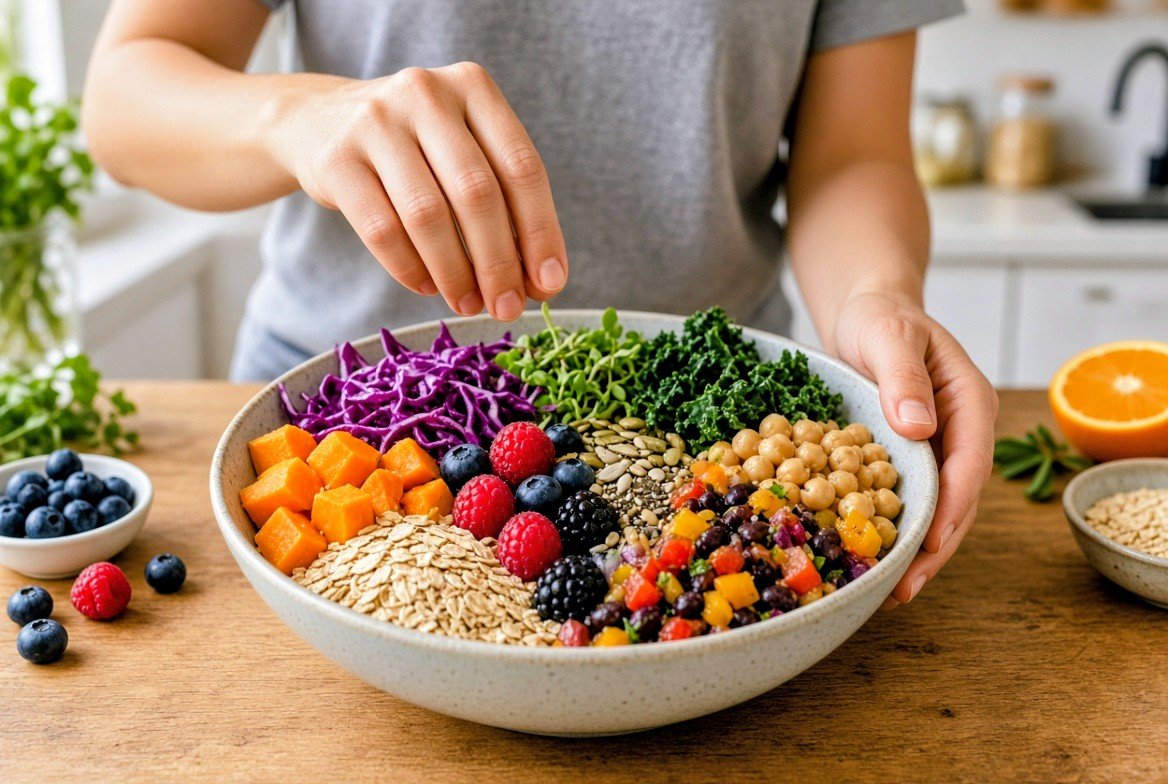
If you’ve scrolled through TikTok or Instagram lately, you’ve probably seen someone piling beans, chia seeds, and berries onto their plate and calling it “fibermaxxing.” So, what is fibermaxxing, exactly? It’s a social media trend built around eating more fiber-rich foods on purpose — but it’s not an official diet or medical treatment [1].
This guide breaks down what the trend actually means, the real benefits and risks, and how to add more fiber without the gas, cramping, or bloating that can come with rushing it.
Quick Wins
- Add one fiber-rich food per day instead of overhauling your whole diet at once.
- Pair beans or lentils with well-cooked vegetables to ease digestion.
- Choose whole fruit over fruit juice for more fiber per serving.
- Read nutrition labels to spot hidden fiber sources in packaged foods.
- Sip water throughout the day as you naturally would — no need to force extra fluids.
Key Takeaways
- Fibermaxxing isn’t a medical term — it’s a trend name for eating more fiber-rich foods regularly.
- Gradual increases matter most; adding too much fiber too fast often causes bloating or cramps.
- Whole foods beat supplements for most people, since they also bring vitamins and antioxidants.
- Fiber needs vary by person, so a healthcare provider can help tailor recommendations.
- Certain digestive conditions require caution, and those readers should check with a clinician first.
Quick Answer: What Does Fibermaxxing Mean?
Fibermaxxing is a social-media term for deliberately increasing fiber intake by eating more fruits, vegetables, beans, whole grains, nuts, and seeds. It is not a clinical diet or treatment, and increasing fiber too quickly may cause gas, cramping, diarrhea, or bloating [1][2].
A few things worth clearing up right away:
- It’s not a medical or clinical protocol — no doctor “prescribes” fibermaxxing.
- There’s no official rulebook or required daily fiber target tied to the trend.
- More fiber isn’t automatically better for every single person.
- The real goal is a balanced eating pattern you can actually stick with.
Did You Know? The Mayo Clinic notes that most American adults eat only about half the recommended amount of fiber each day, which helps explain why this trend caught on so fast [2].
Why Is Fibermaxxing Trending?
From protein talk to fiber talk. For a while, “proteinmaxxing” dominated nutrition content online — protein shakes, protein bars, protein everything. Fibermaxxing is something of a course correction, shifting attention back toward plant foods, digestion, and dietary variety [3].
The UK spelling. UK readers may also see this trend written as “fibremaxxing.” BBC Food covered the trend, noting that many UK adults fall short of recommended fiber intake too [4].
Potential Benefits of Eating More Fiber
Eating enough fiber is linked to several health perks, though it’s worth noting that fibermaxxing itself isn’t a proven treatment for any condition. Current evidence points to these general benefits of adequate fiber intake:
- Digestive regularity — fiber adds bulk to stool and can support regular bowel movements [6].
- Greater meal fullness — fiber-rich foods tend to be more filling, which may help with portion control [10].
- More whole plant foods — a fiber-focused approach naturally nudges people toward fruits, vegetables, and legumes.
- Better overall diet quality — fiber-rich diets are often linked to a broader mix of nutrients [6][10].
Important: Fibermaxxing does not prevent or treat any disease. Evidence is limited on extreme fiber intake, so more isn’t automatically better.
How Much Fiber Do You Need?
Fiber needs depend on your age, sex, and daily calorie intake. The NIH Office of Dietary Supplements notes that general adult recommendations often fall in the range of about 25 to 38 grams per day, with women typically needing somewhat less than men [5].
Your personal number could be different based on your health history, medications, or digestive conditions. A primary care physician or registered dietitian can help you figure out a target that fits your body [6].
High-Fiber Foods to Add Gradually
Whole foods are generally a better starting point than fiber supplements, since they bring extra nutrients along for the ride [2][8].
| Food Group | Examples | Beginner-Friendly Use |
|---|---|---|
| Fruits | Berries, apples, pears, oranges | Add to breakfast or a snack |
| Vegetables | Carrots, broccoli, peas, potatoes with skin | Add one extra serving to dinner |
| Legumes | Lentils, beans, chickpeas | Start with a small ¼ cup portion |
| Whole grains | Oats, barley, brown rice, whole-wheat pasta | Swap for one refined grain per day |
| Nuts and seeds | Chia, flax, almonds, pistachios | Sprinkle a tablespoon onto yogurt or salad |
| Popcorn | Air-popped popcorn | Use as a snack instead of chips |
Tip: Check the Nutrition Facts label — foods with 5 grams or more of fiber per serving count as a “high fiber” source [8].
How to Increase Fiber Without Bloating
If you go from a low-fiber diet to a high-fiber one overnight, your gut needs time to adjust. Here’s a gentler approach:
- Add one fiber-rich food at a time instead of overhauling every meal.
- Start with small portions, especially with beans and lentils.
- Increase legumes gradually over a week or two, not all at once.
- Include a mix of fruits, vegetables, grains, and seeds rather than relying on just one type.
- Drink fluids as you normally would throughout the day.
- Eat slowly and chew thoroughly to ease digestion.
- Jot down a quick note if symptoms show up, without obsessing over every meal.
- Talk to a healthcare provider if discomfort is severe or doesn’t improve.
Warning: Fluid needs vary by person. People with kidney disease, heart failure, or other conditions involving fluid restrictions should not automatically add extra water without checking with their clinician first [7].
Common Fibermaxxing Mistakes
Watch out for these common missteps:
- Adding too much fiber too quickly — this is the number one cause of bloating and cramps [2].
- Using several fiber powders or supplements at once, which can overwhelm digestion.
- Eating mostly one type of fiber, like only oat bran, instead of a variety.
- Ignoring total meal balance, including protein and healthy fats.
- Treating fiber intake like a competition rather than a gradual habit.
- Assuming bloating means the diet is “working” — it usually just means you added fiber too fast.
Fibermaxxing vs. Proteinmaxxing
Neither trend has to “win.” A balanced plate typically includes both fiber-rich foods and adequate protein.
| Trend | Main Focus | Common Foods | Main Risk |
|---|---|---|---|
| Fibermaxxing | Increasing plant-based fiber | Fruits, vegetables, legumes, whole grains, seeds | Rapid increases may cause digestive discomfort |
| Proteinmaxxing | Increasing protein intake | Meat, fish, eggs, dairy, beans, tofu, supplements | May crowd out variety if overemphasized |
| Balanced approach | Variety and adequacy | Protein foods plus plant foods and whole grains | Requires more flexible meal planning |
Safety: Who Should Be Cautious and When to Get Help
Who should check with a clinician first. Talk to a healthcare professional or registered dietitian before making major fiber changes if you have:
- Inflammatory bowel disease (Crohn’s disease or ulcerative colitis)
- Irritable bowel symptoms that are severe or ongoing
- A history of bowel narrowing or obstruction
- Difficulty swallowing
- Kidney or heart disease with fluid restrictions
- A medically prescribed or restricted diet
- Persistent stomach pain or unexplained weight loss
Fiber isn’t automatically harmful if you have a digestive condition, but the right amount and type can vary quite a bit from person to person [7].
When to see a doctor. Reach out to your primary care physician if you notice:
- Persistent diarrhea or constipation lasting more than a couple of weeks
- Bloating that doesn’t improve after slowing down your fiber increase
- Major, unexplained changes in bowel habits
When to seek urgent help (call 911). Get emergency care right away for:
- Blood in the stool, especially if it’s a large amount
- Severe or sudden abdominal pain
- Repeated vomiting that won’t stop
- Unexplained, significant weight loss alongside other symptoms
Your 7-Day Fiber Upgrade Plan
A slow, steady approach tends to work best:
- Day 1: Add one piece of whole fruit.
- Day 2: Choose oats or a whole-grain cereal for breakfast.
- Day 3: Add one extra vegetable serving at dinner.
- Day 4: Try a small serving of lentils or beans.
- Day 5: Sprinkle nuts or seeds onto a meal.
- Day 6: Swap one refined grain for a whole-grain option.
- Day 7: Review which foods felt comfortable, and keep repeating those.
Summary
- Fibermaxxing is a nickname for a fiber-rich eating pattern, not a medical treatment.
- Add fiber gradually and from a variety of foods to avoid bloating and cramps.
- Whole foods are generally a better starting point than relying heavily on supplements.
- People with certain digestive or kidney conditions should talk to a clinician before big changes.
- Watch for warning signs like blood in the stool or severe pain, and seek care if they appear.
FAQs
What is fibermaxxing?
Fibermaxxing is a social media trend that means intentionally eating more fiber-rich foods, like fruits, vegetables, legumes, and whole grains. It’s not an official medical diet, just a popular way to describe a fiber-focused eating style [1][3].
Is fibermaxxing healthy?
Eating more fiber can support digestion and overall diet quality for many people, but it depends on how it’s done. Adding fiber too quickly, or relying only on supplements, can cause digestive discomfort instead of benefits [2].
How much fiber should I eat per day?
General adult recommendations often range from about 25 to 38 grams per day, depending on age and sex [5]. Your personal needs may differ, so it helps to check with a primary care physician or dietitian.
Can eating too much fiber cause bloating?
Yes. Increasing fiber intake too quickly is one of the most common causes of gas, bloating, and cramping [1][2]. Adding fiber gradually over one to two weeks tends to reduce these symptoms.
Is fibermaxxing better than proteinmaxxing?
Neither approach is inherently “better” — most people benefit from a balanced diet that includes both adequate fiber and protein. Focusing exclusively on one nutrient group can mean missing out on others.
Should I use a fiber supplement?
Whole foods are generally recommended as the first choice since they provide fiber along with other nutrients [2][8]. If you’re considering a supplement, it’s worth discussing with a healthcare provider, especially if you take other medications, since fiber supplements can affect how some drugs are absorbed.
References
- Memorial Sloan Kettering Cancer Center: Fiber and Cancer Risk
- Mayo Clinic: Chart of High-Fiber Foods
- Mayo Clinic Press: Is the Fibermaxxing Trend Good for You?
- BBC Food: Fibremaxxing
- NIH Office of Dietary Supplements: Dietary Fiber
- MedlinePlus: Dietary Fiber
- NIDDK: Eating, Diet, and Nutrition
- USDA FoodData Central
- NHS: How to Get More Fibre Into Your Diet
- Harvard T.H. Chan School of Public Health: Fiber
Educational disclaimer: This article is for educational purposes only and is not medical advice. Fibermaxxing is a social-media nutrition term, not a medically recognized diet or treatment. For personal care, talk to your primary care physician or a registered dietitian. Call 911 for emergencies.