
By Pulsvia Team
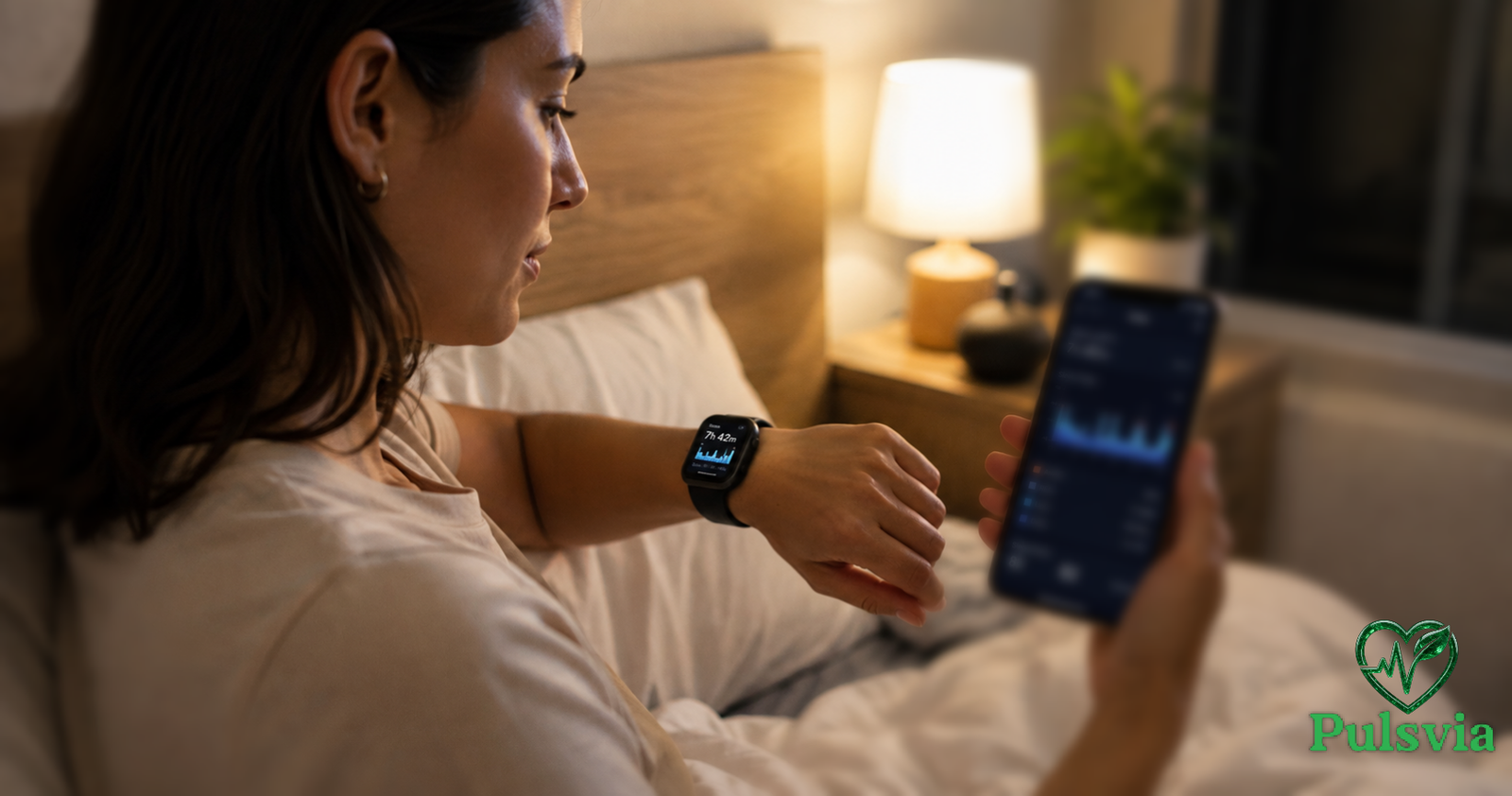
You wake up, check your wrist, and see a sleep score staring back at you. Maybe it says you only got 12 minutes of deep sleep last night, and now you’re wondering if something’s wrong.
Sleep tracker accuracy is a fair thing to question, especially when so many of us rely on wearables to understand our rest. These devices have become part of daily routines for millions of people trying to sleep better.
Here’s what the research actually shows about what these gadgets can — and can’t — tell you.
Key Takeaways
- Sleep trackers estimate patterns like duration and timing reasonably well, but they don’t measure sleep directly.
- Sleep-stage data varies widely between devices and shouldn’t be treated as a clinical result.
- One bad night doesn’t mean much — weekly trends matter more than single scores.
- Trackers can’t diagnose conditions like sleep apnea or insomnia, no matter how detailed the data looks.
- Persistent symptoms deserve a doctor’s visit, regardless of what your device shows.
Quick Answer: Are Sleep Trackers Accurate?
Sleep trackers can provide useful estimates of sleep duration, timing, and general patterns, but their sleep-stage data is less reliable than clinical testing and should not be used to diagnose a sleep disorder.
Sleep trackers can provide useful estimates of sleep duration, timing, movement, and general sleep patterns, but they are less reliable for identifying exact light, deep, and REM stages. Consumer devices should be used for wellness tracking rather than diagnosing or treating sleep disorders.
Some validation studies have found high sensitivity for detecting sleep itself, while sleep-stage classification varies considerably between devices and studies [4].
What Sleep Trackers Actually Measure
Common sensors
Most consumer sleep trackers rely on a combination of:
- Movement sensors (accelerometers).
- Heart-rate sensors.
- Optical pulse sensors.
- Skin temperature sensors in some devices.
- Algorithms that combine these signals into an estimate.
Common outputs
Based on that raw data, your device typically generates:
- Estimated time asleep.
- Time in bed.
- Sleep and wake timing.
- Nighttime awakenings.
- Heart rate patterns.
- Estimated sleep stages.
- An overall sleep score.
Important: Your device doesn’t directly “see” sleep stages the way a clinical sleep study does. It’s making an educated guess based on movement and heart-rate patterns.
Sleep Versus Wake: Where Trackers May Perform Better
Here’s where things get interesting. Many consumer devices are better at figuring out whether you’re asleep or awake than at pinpointing which stage of sleep you’re in.
Research comparing commercial wearables with polysomnography — the gold-standard clinical sleep test — found strong sleep-detection performance in some devices, though results vary by device, user, and study design [3].
Did You Know? Consumer trackers often perform better at estimating sleep versus wake than identifying exact sleep stages [4].
Sleep-Stage Accuracy: Light, Deep, and REM Sleep
Why sleep-stage estimates vary
A number of factors can throw off stage estimates:
- Different sensor types across brands.
- Different algorithms interpreting the same signals.
- Device fit and placement on your wrist or finger.
- Movement during sleep, including tossing and turning.
- Individual physiology — no two bodies produce identical signals.
- Short or fragmented sleep, which is harder to classify.
- Differences in how each device was validated in research.
Do not overinterpret one night
A single “low deep sleep” or unusually high REM reading shouldn’t set off alarm bells. Sleep naturally varies night to night based on stress, alcohol, illness, and even how warm your room was.
Tip: Compare weekly patterns rather than fixating on one night’s numbers. A single unusual score is often just noise.
Consumer Tracker Versus Clinical Sleep Study
| Feature | Consumer Sleep Tracker | Clinical Polysomnography |
|---|---|---|
| Sleep timing | Estimated | Measured using clinical signals |
| Sleep versus wake | Often useful estimate | Clinical measurement |
| Sleep stages | Approximate estimate | Clinically scored using brain and body signals |
| Breathing problems | May flag patterns on some devices | Can support medical evaluation |
| Diagnosis | Not a diagnostic tool | Used by qualified professionals when appropriate |
| Setting | Home and everyday use | Sleep laboratory or approved clinical setting |
The American Academy of Sleep Medicine states that consumer sleep technologies should not be used to diagnose or treat sleep disorders, since validation and FDA-clearance limitations remain important considerations [1].
How to Use Sleep Tracker Data Responsibly
Look at trends, not one-night scores
Review several weeks of data where possible, rather than reacting to any single night.
Compare data with how you feel
Your tracker doesn’t know the whole story. Weigh the numbers against:
- Daytime alertness.
- Mood.
- Concentration at work or school.
- Exercise recovery.
- How consistent your sleep timing has been.
Use the data to test habits
Trackers can be a decent tool for informal experiments. For example:
- Does a consistent wake time change your estimated sleep duration?
- Does late caffeine line up with shorter recorded sleep?
- Does a cooler, darker room improve your weekly trend?
Just don’t treat a sleep score as proof that a habit definitely worked or failed — it’s one data point among many.
When Sleep Data Can Create Anxiety
Orthosomnia and sleep perfectionism
Becoming overly focused on hitting a “perfect” sleep score may increase worry and, ironically, make sleep harder for some people.
Signs to take a break
Consider stepping back from your tracker — or at least turning off notifications — if you notice yourself:
- Checking sleep data repeatedly throughout the day.
- Feeling distressed by normal night-to-night variation.
- Changing your entire routine because of one unusual score.
- Spending more time worrying about sleep than actually working on your routine.
Quick Win: Turn off sleep-score notifications if they make you anxious. You can still check the data on your own schedule.
What Sleep Trackers Cannot Diagnose
It’s worth being direct here: a wearable device cannot diagnose any of the following conditions:
- Sleep apnea.
- Insomnia.
- Narcolepsy.
- Restless legs syndrome.
- Depression.
- Heart disease.
- Diabetes.
- A specific sleep-stage disorder.
Warning: Do not use a wearable to rule out sleep apnea or another disorder. A tracker may show a pattern worth mentioning to your doctor, but it cannot replace a proper medical evaluation.
When to Speak With a Doctor
Reach out to your primary care physician if you notice:
- Loud, habitual snoring.
- Gasping or choking sounds during sleep.
- A bed partner reporting repeated breathing pauses.
- Severe daytime sleepiness that interferes with daily life.
- Falling asleep while driving.
- Persistent insomnia that doesn’t improve with routine changes.
- Repeatedly abnormal tracker readings alongside real symptoms.
A tracker result alone doesn’t establish a diagnosis — it’s a starting point for a conversation, not an answer in itself.
A Simple 7-Day Sleep-Data Review
Try this practical process to get more value from your tracker data:
- Record your bedtime and wake time each day.
- Note your caffeine timing.
- Track alcohol, exercise, stress levels, and any naps.
- Record how alert you feel the next day.
- Look for patterns across several nights, not just one.
- Change one habit at a time so you can see what actually helped.
- Discuss persistent symptoms with a healthcare professional.
Summary
- Treat your tracker as a wellness tool, not a medical device — it estimates, it doesn’t diagnose.
- Focus on weekly trends instead of reacting to any single night’s score.
- Watch for signs of sleep-data anxiety and scale back tracking if it’s adding stress instead of insight.
- Bring real symptoms to a doctor, not just a screenshot of your app.
- Use the data as a starting point for testing habits like caffeine timing or room temperature.
FAQs
Are sleep trackers accurate for REM and deep sleep?
Sleep-stage estimates, including REM and deep sleep, vary quite a bit between devices and aren’t as reliable as clinical testing. They can offer a rough sense of patterns over time, but individual stage readings shouldn’t be treated as precise measurements [4][5].
Can a smartwatch detect sleep apnea?
Some devices may flag breathing-related patterns, but this isn’t the same as a diagnosis. Sleep apnea requires proper medical evaluation, often through a sleep study ordered by a clinician [1].
Is a sleep score scientifically accurate?
A sleep score is a simplified summary generated by an algorithm, not a clinical measurement. It can be useful for spotting general trends, but evidence is mixed on how well these scores reflect true sleep quality [4].
What is the most accurate way to measure sleep?
Polysomnography, performed in a sleep lab or approved clinical setting, remains the clinical standard for measuring sleep stages and diagnosing sleep disorders. Consumer trackers are a convenient alternative for everyday trend-watching, but they’re not a substitute for clinical testing [1][3].
Should I trust the sleep data from my wearable?
You can use the data as a general guide for spotting patterns, like how caffeine or room temperature affects your sleep. Just don’t rely on it to rule out or confirm a medical condition — performance varies by device and person [3][4].
References
- AASM: Consumer Sleep Technology Position Statement
- AASM: Wearable Sleep Technology — Clinical Use and Best Practices
- NIH/PMC: Accuracy of Commercial Wearable Devices for Sleep
- NIH/PMC: Accuracy of Consumer Sleep-Tracking Devices
- NIH/PMC: Reliability of Wearable Sleep-Stage Devices
- NIH/PMC: Validation of Six Wearable Sleep Devices
- NIH/PMC: Performance of Consumer Sleep-Tracking Devices
- NIH/PMC: Consumer Sleep-Tracking Technology Review
- Mayo Clinic: Sleep Tips
- Sleep Foundation: How to Sleep Better
Educational Disclaimer
This article provides general information about consumer sleep-tracking technology and does not diagnose, treat, or rule out any sleep disorder. Speak with a qualified healthcare professional about persistent sleep problems, severe daytime sleepiness, breathing concerns, or other symptoms.
For personal care, talk to your primary care physician. Call 911 for emergencies.